
Cosmology - Particle Physics & The Big Bang
OPENING QUESTIONS: Rewrite this statement I used to pose to my freshmen during our Astronomy Unit to make it more scientifically accurate:
"The Big Bang occurred about 13.7 billion years ago. At that moment, all the energy, atoms, planets, comets, galaxies and everything else we see in the Universe was created in a titanic explosion."
OBJECTIVE:
I will be able to sketch basic atomic structure showing fundamental particles (Today)
I will be able describe the Universe within the first 3 minutes of "Planck Time" after today's class (Probably Tomorrow)
WORDS FOR TODAY:
- Planck Time
- Proton (a non-fundamental particle, contains u-u-d quarks, has +1 charge)
- Electron (a fundamental particle of nature, has -1 charge)
- Neutron (a non-fundamental particle, contains d-d-u quarks)
- Up Quark (a fundamental particle of nature, has + 2/3 charge)
- Down Quark ((a fundamental particle of nature, has -1/3 charge)
- Strong Force (between quarks)
- Weak Force (not exactly a force)
- Electromagnetic force (between protons & neutrons)
- Gravity (between objects with mass)
WORK O' THE DAY:
═══════════════════════════
Now let's take a look at our opening question....
There are a lot of misconceptions about the Big Bang.... specifically what happened when.
We'll work on building our own timeline in a moment-- before we do that, we need to learn some basic particle physics and before we do that, we need to recall the basic structure of an atom. Please work with your team to define:
- Proton
- Neutron
- Electron
Let's make flashcards for those along with the two types of quarks in our work list o' the day
═══════════════════════════
Please grab a 3 - 4 ft section of butcher paper and work with your team to:
- Draw vertical lines to separate your page into 4 approx equal segments
- Use most of the left panel to sketch a hydrogen atom (best as you can-- if you've had chem please take the lead here!)
- Use most of the 2nd panel to sketch a helium atom (what is different here?)
- Sketch a horizontal line to split the 3rd panel into approximate (vertical) halves.
- On the top half suggest/hypothesize or otherwise guess at the inside of a proton
- Draw a horizontal line to split the 3rd panel into approximate (vertical) halves.
- On the top half suggest/hypothesize or otherwise guess at the inside of a neutron
═══════════════════════════
Now let's review fundamental particle structures - YAY!
═══════════════════════════
Now let's learn a wee bit about the four (4) forces of nature:
1) Gravity -- The force whereby any object with mass interacts with any other object of mass. The defining features of that force are the mass of the two objects involved, and the distance separating those two objects. Gravity is moderated by the 'graviton' particle
2) The Strong Force: The Strong Force is the force that holds quarks together inside protons and neutrons. The strong force only acts on VERY small distances. However the strong force has an unusual property in that the farther apart the quarks, the stronger the force between them. The Strong Force is moderated by the 'gluon' particle.
3) The Weak Force: The Weak Force is the force responsible for certain types of radioactive decay in the nucleus of an atom. The Weak Force is much, much weaker than the Strong Force (as you'd suspect) and is moderated by the W and Zo(pronounced "Z naught") particles
4) The Electromagnetic Force: The Electromagnetic force is the positive/negative attraction between protons and electrons inside an atom. The particle that moderates that force is our good friend, the photon.
Let's work with our groupies to develop OUR OWN timeline on a 3 x 3 foot slab of paper. You are free to use the images on today's lesson plan or to search for your own.
The rules are simple-- please do NOT put anything on your timeline that you don't understand. If there are words or terms that look familiar that you need clarification on, please write them down on a separate sheet and I'll review those with you.
Let's take a look at these graphics:
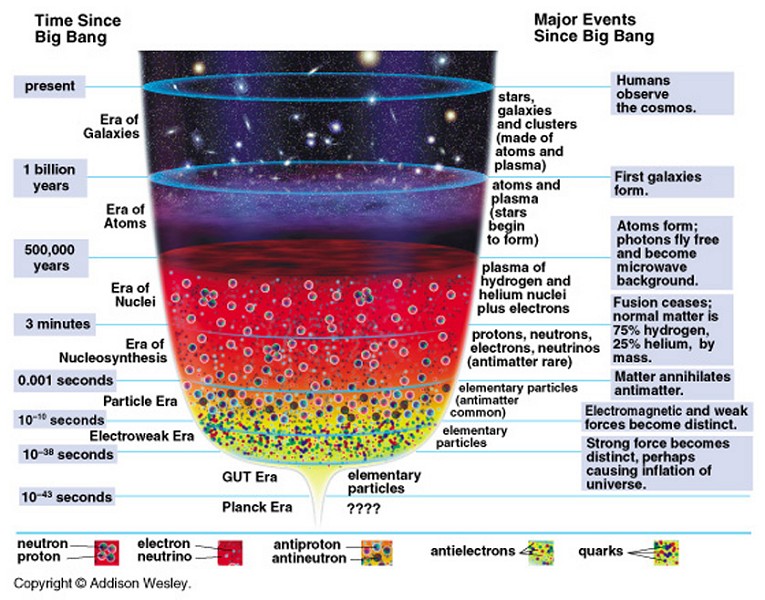
Some parts of this graphic will be new material, however if you look closely you WILL see some familiar objects...
Please take a few moments to use this graphic to re-write your response to the opening question.
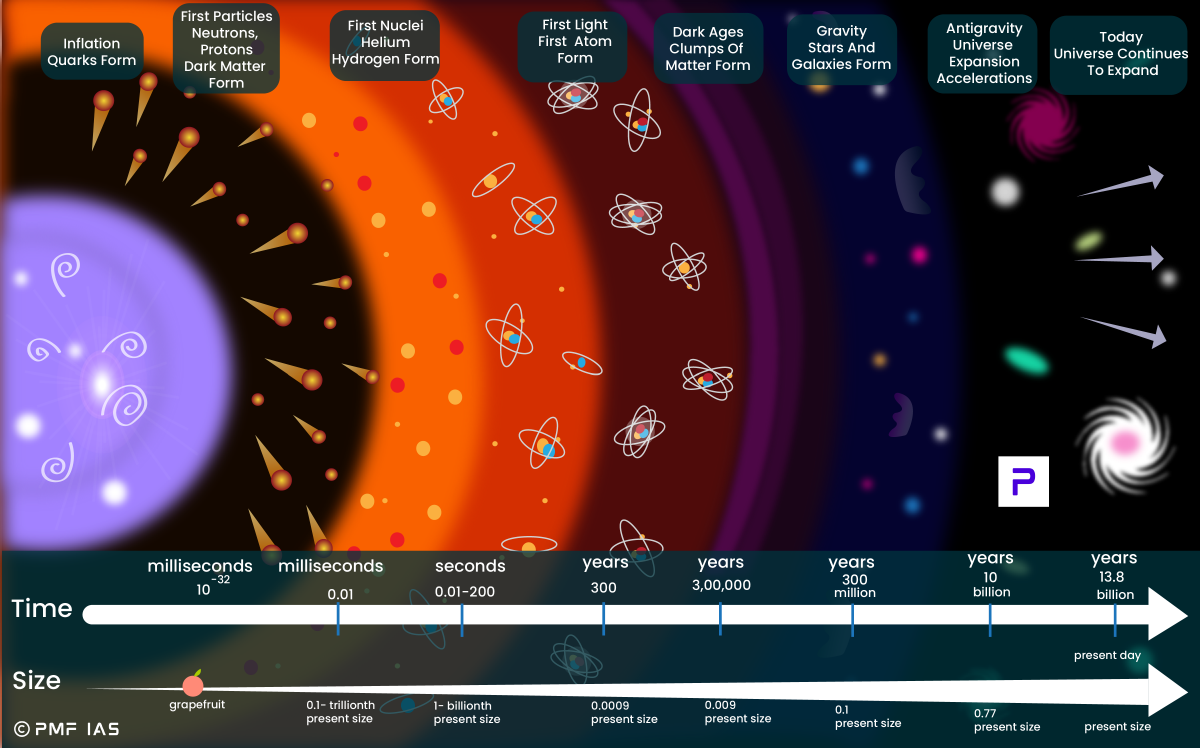
Time |
T ( °C) |
Event |
10-43 Sec |
1032 |
Planck Time: The cosmos goes through a super fast “inflation,” expanding from the size of an atom to that of a grapefruit in a tiny fraction of a second. |
10-32 Sec |
1027 |
Post-inflation: the universe is a seething, hot soup of electrons, quarks, and other particles. |
10-6 Sec |
1013 |
Basic Matter Forms: A cooling cosmos permits quarks to clump into protons & neutrons. |
10-3 Sec |
1013 |
Matter/Anti-matter annhialation: Most anti-matter destroyed, gamma light created |
3 min |
108 |
Dark Era: Still too hot to form into atoms (protons w/electrons) so visible light isn't created |
300,000 years |
103 |
Light Finally shins: Electrons combine with protons & neutrons to form atoms, mostly hydrogen & helium. Lithium & beryllium were formed in trace amounts. |
~1 billion years |
-200 |
Stars & Galaxies Form: Gravity makes hydrogen and helium (primordial elements) coalesce to form the giant clouds that will become galaxies; smaller clumps of gas collapse to form the first stars. |
13.7 billion years |
-270 |
Current Era: As galaxies cluster together under the influence of gravity, the first stars die and spew heavy elements into space: those will eventually turn into new stars and planets. |
Planck Time is particularly interesting:
Planck Time is 10-43 seconds after the Big Bang... that would be one ten millionth of a trillionth of a trillionth of a trillionth of a second after the Big Bang.
Planck Time is the LAST time all of the 4 forces of nature were all clumped together as one force.
As the Universe expanded past Planck Time, the gravitational force peeled away to become a unique and separate force. We currently don't have data to understand how that happened, but scientists are working to develop a Grand Unified Field Theorem (sometimes called the Theory of Everything) that is something of the Holy Grail of particle physics.
However, we do have very good theory and math to help us understand the Universe up to about 10-37 seconds after the Big Bang.
The interesting aspects of this are that we don't think we'll *ever* be able to get any closer than 10-43 seconds after the Big Bang. We just don't have the beginnings of any sort of theory or math to serve as a basis for doing that.
═══════════════════════════
With that in mind, please remember that you aren't responsible for the minutiae of the Big Bang time line, just the aspects shown above AND the *original* source of the Cosmic Background Radiation....
Please grab your forbidden electronic devices, and see if you can find an explanation of where the original light of the Universe came from in a succinct and coherent way for us to discuss...